Please note: the list of our seeds for sale is on the blog entry made just before this one, entitled 2015 Seed List. Most varieties are still available.
Working Together To Build The California Seed Network
Seed rEvolution Now and Organic Seed Alliance make a great team! A lot of work has been happening over the past year, as we empower farmers and educate people about open-pollinated seeds. Here are some of the highlights of that effort. You'll see that Steve and his allies have been very busy!
EcoFarm Conference at Asilomar
This past January, at the EcoFarm Conference at Asilomar in Carmel, California, Steve had the opportunity to put together a presentation to lay out his dream of a coordinated network of organic seed growers.
 |
| Steve Peters of Organic Seed Alliance and Seed rEvolution Now |

The Pre-Conference, entitled Cultivating Organic Seed Stewardship, was well attended, and the participants hungry for information. The expert panel was happy to oblige.
 |
| Jared Zystro of the Organic Seed Alliance |
 |
| Rowen White of the Sierra Seed Cooperative |
 |
| Tim Van Wagner of First Rain Farm |
 |
| Don Tipping of Siskiyou Seeds and Family Farmers Seed Cooperative |
 |
| Aaron Dinwoodie of Tunitas Creek Ranch |
 |
| Permaculturist Benjamin Fahrer |
Our friend Benjamin served as scribe for the meeting.

The day sped by, as the group delved deep into the complex issues around protecting, preserving, and improving our genetic crop heritage.

Even the breaks were filled with lively discussions!

We are so grateful to our dear friend Ken Dickerson (at left, with Benjamin Fahrer). As Executive Director of the Ecological Farming Association, which presents the EcoFarm Conference each year, his encouragement and support of the seed work is invaluable. Everything comes down to the people who get the vision and do the work!

During the Conference, Steve was interviewed by Greenhorns; another opportunity to get the message out.
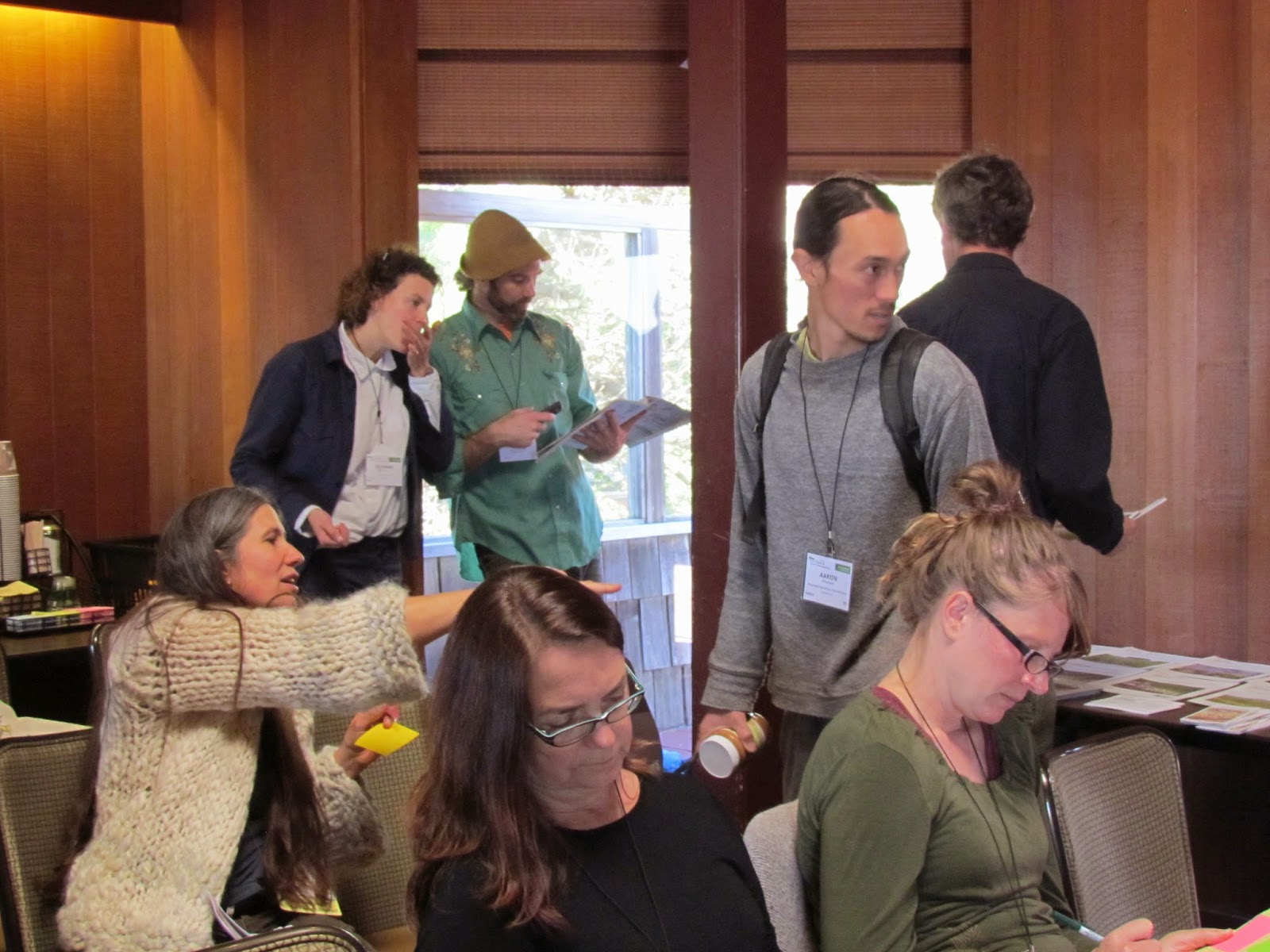
Later during the three-day conference, OSA presented a California Seed Stakeholders meeting, attended by folks both new to and old hands at seed saving.

Jared Zystro organized the meeting to maximize participation, with each person placing post-its of their main concerns in different areas. Yes, that's eco-warrior Gary Nabhan in attendance. He has a long history of involvement with traditional seeds, and was one of the founders of Native Seeds/SEARCH.
California Seed Summit in Sacramento
Continuing the momentum from EcoFarm, in February OSA organized the first California Organic Seed Summit. This event was organized by Jared Zystro, Steve Peters, Rowen White, Kalan Redwood, Benjamin Fahrer, and Leyla Cabugos.

This was a two day gathering of over 30 seed enthusiasts, growers and small seed companies, sharing their common passion for seed with the intention of strengthening our local and diverse seed systems.

Held at the beautiful Rudolf Steiner College near Sacramento, the venue helped to inspire a successful meeting. Wonderful participants inspire hope for a fertile future! The take-home action points include:
1) Creating a crop and seed database
2) Marketing with an emphasis on education
3) Developing a code of ethics, including transparency
4) Establishing connections, including field days
Sierra Seed Seva Workshops on San Juan Ridge

Dynamic seedster Rowen White has created a model of bioregional seed sovereignty with the Sierra Seed Cooperative. Steve was invited to bring some of his experience to the budding seed sevas. It is always wonderful to help inspire young, energetic farmers...they inspire us!
Fundamentals of On-Farm Seed Production in Sebastapol

Steve and Jared taught a class on seed production in Sebastapol which was very enthusiastically received. This was an all-day, somewhat more advanced workshop. A group there, headed by Sara McCamant, maintains a seed garden on the grounds of a local church. This is the town where Luther Burbank did his seed work, and folks there still understand how important it is to maintain the legacy.

Beet Seed Security in Pescadero
 |
| Stripping seed from mature beet plants, done over 1/4" hardware screen for rough cleaning. |
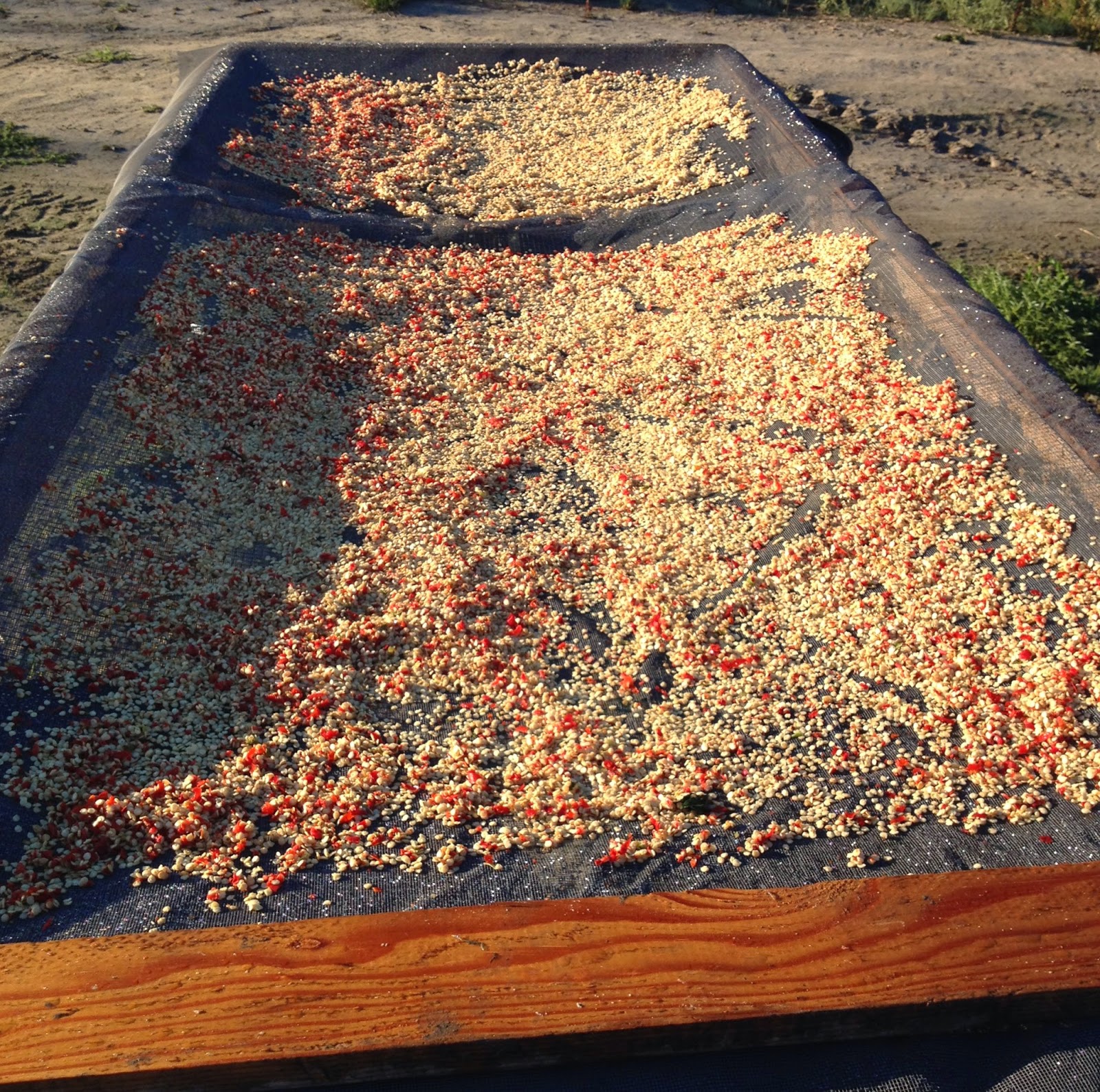
When our friends at Fifth Crow Farm couldn't find seed for their favorite beet variety, Steve helped them learn to use their last harvest to produce fresh seed.
 |
| Seed drying in greenhouse after preliminary field cleaning (scalping). |
Seventy-five roots produced about 60 lbs. of clean seed; enough to market as well as plant. Now they know how to have seed forever!
Corn Freedom in Solano County

Restauranteur Matthew Engelhart contracted Steve to find a suitable corn for making tortillas and tamales for his successful Gracias Madres restaurant in San Francisco. He grows much of the produce used in the Cafe Gratitude chain of vegan eateries owned by his wife Terces and him.

Along with this photo, Matthew sent an urgent text message: "Houston, we have a problem!" Happily, the plants' ascent peaked at 15 feet. They produced abundant ears of large white kernels prized by the Mexican chefs.

Now Be Love Farm can produce their own great corn for Gracias Madres' great tamales...and over time, select for the attributes that make it even better suited to their specific needs.
Trialing Carrots in Gilroy

Nash and Patty Huber, long-time organic seed growers from the Olympic Peninsula, were in California for the EcoFarm Conference. While here they visited one of Ronald Welten's fields to see (and taste!) how their Rumba carrot stacks up against other Nantes varieties in an OSA trial Steve and Jared ran.
Comparing Colored Carrots in Panoche

Seedsman Grant Brians at his family's farm in Hollister. Grant owns Gourmet Seeds International, as well as running an organic produce business. He also farms acreage in the Panoche Valley, in the wilds of southern San Benito County.

USDA carrot breeder Phil Simon was thrilled to see how his varieties of orange, yellow, purple and red carrots performed in an OSA trial held at this isolated commercial vegetable farm.
More Carrot Trials in Panoche

Carrots thrive in sandy loams like this, but hot, dry, and windy conditions can be challenging. The combination makes this an ideal place to run a trial. Plants that do well here exhibit the qualities farmers will need to cope with climate change.
Seed Grow-Outs in From the Coast

Commercial cauliflower seed production, snap pea seed increase, and a garbanzo trial are being conducted by enterprising farmer Ryan Casey and his good dog Lucky of Blue House Farm in the lovely Pescadero Valley. Steve is trying to find growers within about 100 miles of San Francisco with whom he can work. The range of climates within that area is staggering!
Sharing Seeds in Sunol

Krysten, a farmer at the Ag Park at the Sunol Water Temple, will be making a seed selection for heat tolerance of Steve's Tender Early Green Broccoli. She can still use it as a market crop, which makes the project doable for this small-scale grower.
Preserving Heirlooms in Corralitos

Steve shows off valued open-pollinated seeds to Zea Sonnabend and Shane Murphy of Fruitilicious Farm. They will be growing rare snap beans for evaluation and seed increase, and trialing several bunching carrot varieties.
Trials, Multiplication, and Commercial Production in Aromas

Farmer Robert Brunet is an enthusiastic seedsman who worked for the Agriculture and Land-Based Training Association in Monterey County (ALBA) before starting his own farm. He's growing broccoli seed to sell, Swiss chard and snap peas to increase seed stocks, and trialing snap beans and various brassicas.
Extensive Trials and Seed increase at Sunol

Seedsman Aaron Dinwoodie will be growing out and fresh-marketing almost the entire Seed rEvolution Now inventory (please see our previous post for the list). He's growing these along with other rare, yet promising, open-pollinated crop varieties at the Ag Park. The warmer conditions in Sunol will give us an idea of how these crops perform away from the coast. It is also an ideal place to increase okra and beans.
Breeding For Climate Change in Shively

Hidden away behind the Redwood Curtain, a fortuitous bend in the Eel River has created the fertile Shively Flats. Farmer Bill Reynolds settled here over thirty years ago.

 |
| At Full Belly Farm, Steve brings seed grower Bill Reynolds together with farmers to discuss how their agronomic needs may be met. |
Steve and Bill have been working on plant breeding together for well over twenty year. With several successful projects already accomplished (see our earlier blog entries on Shiraz Tall-Top Beet and Dark Star Zucchini for more details), they are looking ahead to make new selections of stronger, more drought tolerant crops to help organic famers thrive in an uncertain climatic future.
For more information about any of these on-going projects, or to learn about how you might work with Seed rEvolution Now, please call Steve Peters at 505-660-3933, or email him at stevegrows@gmail.com