Showing posts with label saving seed. Show all posts

Monday, October 27, 2014

Red Ruffled Pimiento

This little known culinary treasure deserves some limelight. It is high time for cooks and foodists to try it and see just how delicious a ripe red pepper can be!


Believed to be derived from a Spanish paprika pimiento. this squat, lobed fruit is far and away the most flavorful, aromatic, and rich sweet pepper ever. We were giving out samples at Hoes Down Festival this fall at Full Belly Farm in the Capay Valley, and everyone was in agreement: best tasting pepper they'd ever tried!

We've loved this variety for over twenty years. Steve worked professionally with organic seed growers around the country. He has kept up many of those connections, who have become good friends. One of them was John Finley of the Garberville Community Farm. 

John and his wife Lisa have been growing produce and saving seed for many years. They received the Red Ruffled Pimiento seed from grower Bill Reynolds, grew it out and made some improvement selections on it.


One of the improvements made was to the size of the fruits. They run 3-4" in diameter, and about 2" high. The walls are over 1/4" thick; much thicker than the familiar Bell Pepper.

The seed then went back to Bill's farm, Eel River Produce. We visited this past March. The photo above shows a cover crop waiting to be plowed in on this beautiful certified organic land. 

In March Bill was transplanting Red Ruffled seedlings.

By the time Steve returned, in late September, each plant held from 6-15 fully ripe peppers, and a number of ripening ones. You can easily ripen twenty fruits per plant with an extended growing season.

I love how Bill made use of his resources: he took advantage of a weed problem, datura, to provide shade for the pimientos. Peppers are by nature understory plants, and the taller Jimson Weed prevented sun scald on the peppers.

September 30th was harvest day, Steve single-handedly picked 300 gallons of ripe fruit. How many pecks of perfect pimientos can Steve Peters pick? You do the math. Pretty good for an old timer! Just part of the personal service from Seed rEvolution Now!

One of Bill's thrills is finding ways to use the bamboo that thrives on his farm. Here's a handmade seed drying screen, which was pressed into service as a pepper ripening rack. Very aesthetic!

To process the seeds, Bill ran the fruit through a Millet Wet Seed Separator. This first chops the fruit, and then passes it over a shaking tray through which water is sprayed, pushing the seed through the screen and into the sluice box. The seed-free flesh is saved for food.

Bill in his waterproof pants rubs the seed through the screen by hand.

The seed and fine pulp go down the homemade redwood sluice. 

Check dams catch all but the heavier, viable seeds.

These are caught in a mesh screen at the bottom.

Nice small-scale, low-cost operation for the on-farm seed saver!
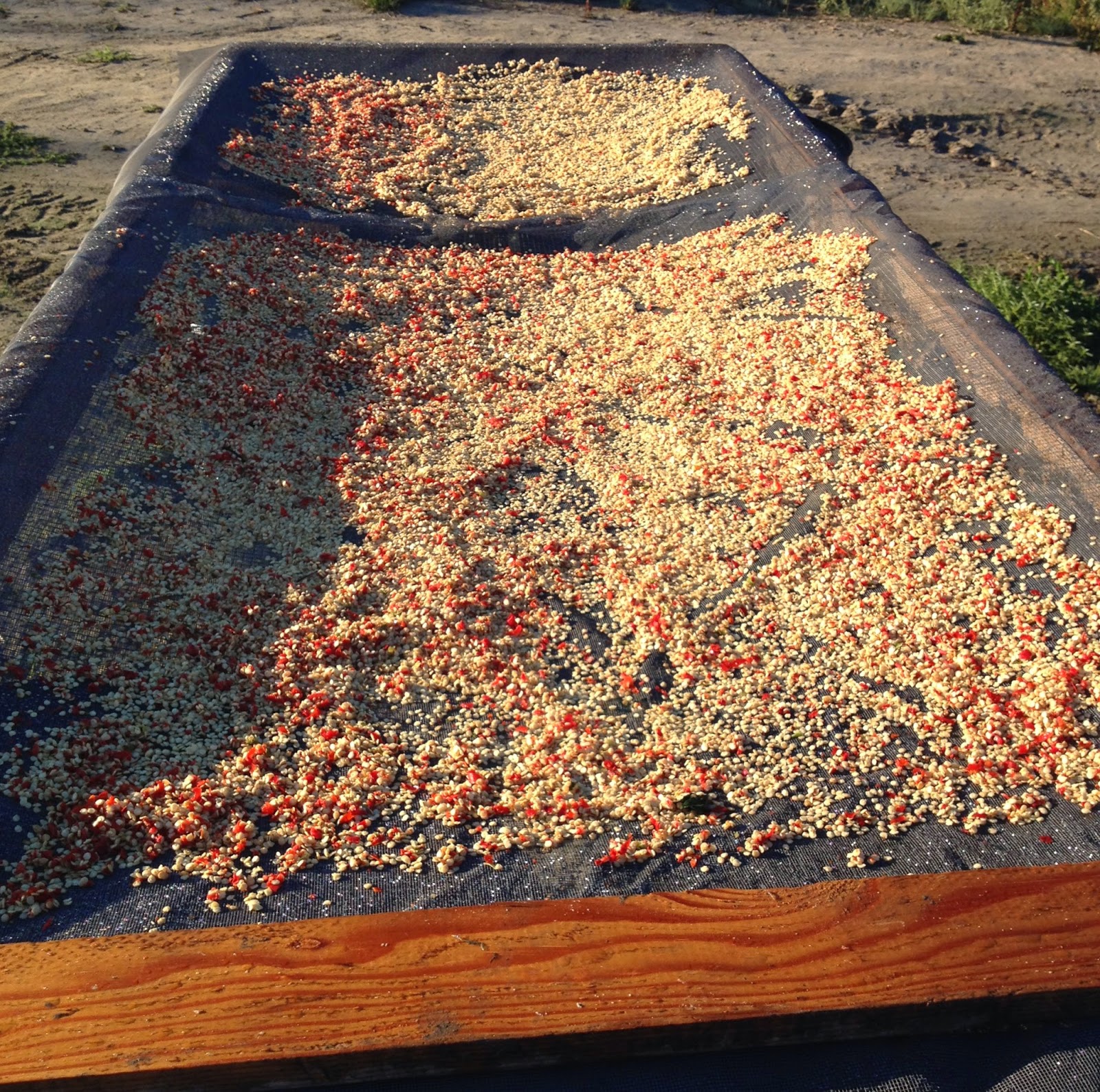
After the seed dries, it will go through a final winnowing to blow away the flecks of dried flesh. Then it's ready to go off to farmers and seed companies. Steve is representing Bill and several other trusted organic seed producers through Seed rEvolution Now. The price is $125 per quarter pound, although he is willing to sell smaller lots as well. You can email him at stevegrows@gmail.com, or call him at 505-660-3933.

Here's some shots of the fruit soon after it came to our home in San Mateo. I just can't say enough about the fantastic fresh eating quality of these peppers! But I'll try...

Thick, meaty, sweet, juicy, aromatic, rich and delicious!

And they make wonderful stuffers! Unlike Bell and Relleno type peppers, these have a tender skin and do not require peeling. Toothsome stuffed pimientos!

One last point in favor of these beauties: Here's a photo I just took today, October 27th, of a Red Ruffled Pimiento kept nearly a month without refrigeration! Pretty amazing, considering it was picked fully ripe! So hurry and get some of this seed to offer in your catalog or grow for your customers. Try it in your kitchen, give your kids a slice. It is just too good to pass up!

Friday, June 28, 2013

Seeds In a Nutshell

The Basics of Seeds

Contained in a package which is both resistant to decay and yet biodegradable, a seed is the epitome of potentiality. Every open-pollinated seed contains the genetic code to not simply reproduce the traits of its parents, but of all its ancestors. Each seed is a veritable treasure trove of diverse traits, and those varieties that have lasted up to the present time have done so because they carried traits which enabled the plants to be maintained, year after year, under the care of human farmers.

Land Race, Heirloom, Open-Pollinated, Hybrid, GMO, and Patented Seeds
What is the Difference?

Agriculture developed as observant gatherers saved the seed of the plants they thought were best to replant near their homes. Thousands of years of deliberate selection brought us to a time of untold genetic wealth. Seed for a specific variety was selected by a farmer because of certain traits observed in that plant. It may have resistance to a disease common in the farmer's region. It may be especially productive. It may be particularly delicious. Hopefully it combines several desirable characteristics. For some reason it has stood the test of time.

Mural of Mississippian woman cultivating corn. Illinois State Museum, Dickson Mounds. Artist, Andy Buttram.

The attributes of any crop grown in a particular region will gradually differentiate from related crops in other areas. This is simple evolution, enhanced by human selection based on many cultural and environmental factors. One village's corn may be especially good for making posole (hominy), while in the next valley over there's a village famous for the delicious tortillas. Each isolated crop will contained a broad spectrum of possible traits within its genetic code, enabling it to thrive in spite of annual vicissitudes in local climate. For example, one year the shorter, stockier plants may survive when there's little rainfall, while in a wet year the tall plants do better. Local farmers will get a harvest in spite of conditions. This broad crop type is called a Landrace, and this is how humans have survived for the past ten thousand years.

A Landrace of tomatillos called Purple Keeper, demonstrating diversity in color

The next refinement in seed-saving picks one expression out of the Landrace's multiple possibilities, and refines and improves it. When a particular selection of plant cultivar is saved over many generations, it is considered an Heirloom. Heirloom Seeds are always, by definition, open-pollinated. This means that seed collected from the plant will reproduce true-to-type, as long as there was no cross-pollination with another related variety (more on this later). Heirloom crops include treasured selections such as Brandywine Tomato, revered for its flavor, and Lemon Cucumber, a reliable producer.

Lemon cucumbers ripened for seed

In the 1930s the Hybrid Revolution began. Hybrids are not open-pollinated; they are rather the result of a careful process of controlled fertilization, created by crossing two or more inbred lines in order to achieve desired traits. Thus, hybrids result in plants which will not reproduce true-to-type. They may be sterile, as with mules, or they may exhibit any random combination of genes from their ancestry. This was a boon for commercial plant breeders, as farmers could no longer grow their own seed, and had to purchase new seed for each season. Hybrid breeding has had the benefit of huge amounts of time, effort and money inputs in order to produce profitable seeds.

It is significant, if little known, that traditional open-pollinated breeding techniques hold the potential to achieve all of the advantages of hybrids, including vigor, disease resistance, and yield, and at significantly lower seed cost to the farmers. What is needed to achieve this is funding for prolonged research and development. This is what our land grant university system once did, and could do again if public pressure is brought to bear!

Stella Blue winter squash is an O-P developed for organic production conditions

GMO (genetically modified organism) seed is created by the actual manipulation of the DNA of the plant in a lab. Gene splicers have inserted foreign genetic material into their subjects, including animal genes into plants. A famous case is still a heated controversy. Bacillus thuringiensis, a bacteria which kills the larval stage of butterflies and moths, was used by organic farmers and gardeners to control many crop pests in an environmentally safe way. GMO Bt corn was developed to eliminate the need for spraying. Sounds good? Unfortunately, the Bt proved to be carried by the wind-born corn pollen. Settling on milkweed stands away from the corn field, the toxin killed one half of all the monarch butterflies in the country in one season. In addition, there is evidence that this bacillus is detrimental to intestinal flora of mammals, including farm animals, as well as humans. It is illegal to save the seed of GMO plants, and the corporations which hold the patents are determined to prosecute any infringements.

Monarch caterpillars on a milkweed leaf dusted with pollen

In addition, there are two legal ways which restrict the right to save seeds. The Plant Variety Protection Act of 1970 offers intellectual property protection for non-hybrid seed propagated crop plants. To sell the seed of a PVP variety, the seller must pay royalties to the developer. This enables seed breeders to receive appropriate compensation for their work, while still allowing farmers to save seed and use the material in their own breeding programs. 

The second type of patent is the Utility Patent, which is much more restrictive. Any seed with a Utility Patent cannot be saved, resold, or used in breeding. This removes all access to this genetic material by the general public, consequently removing precious biodiversity from the public domain in a time of increasing climatic instability. The Utility Patent is a dream come true for corporations set on the monopolization of our food resources. Alarmingly, even general agronomic traits, such as drought resistance, can be placed under Utility Patents. 

Monarch on milkweed

We do not pretend to be without bias in this blog. The stakes are too high. We are running out of time to save the wealth of genetic diversity passed down to us from our forebears. Already, in the seventy years since hybridization became the norm for seed companies, we have lost an estimated 70-80% of the varieties that were available a century ago. This is a worldwide phenomenon. The problem is succinctly explained by Dr. John Navazio, senior scientist at Organic Seed Alliance and Washington State University seed research and extension specialist, in his recent book The Organic Seed Grower:

"In the 1980s major oil, agrochemical, and pharmaceutical companies started to buy many of the major seed companies worldwide, having recognized that seed was an untapped intellectual property resource of major proportions for the future. Seed company mergers became the order of the day, and by the mid-1980s Royal Dutch Shell, through a series of mergers and acquisitions, became the largest seed company in the world.

Decisions on the direction of research or the types of services the seed companies would direct toward different market sectors were now made by corporate managers or "bean counters" and were no longer under the purview of agronomists. Many minor agricultural regions, market sectors, and crop types were increasingly ignored as the bean counters from corporate headquarters eliminated the breeding programs and crop varieties that served the least lucrative markets. Increasingly, the commercial development of agricultural seed was directed at the highest-profile, highest-profit market: farms on prime agricultural land in large-scale, centralized production areas that are favored by agribusiness. This trend resulted in a narrowing of the breeding focus by all of the seed companies. The deathwatch for regionalism in commercial seed was beginning."

~~~~~~~~~~~~~~~~~~~~~~~~~~~~~~~~~~~~~~~~~~~~~~~~~~~~~~~~~


Saving Seeds
A farmer or gardener today can join in the traditional practice of saving seeds by learning the art of observation and practicing careful husbandry of the genetic puzzle which each variety reflects. Many crops are relatively simple to save, and some can be grown in a small amount of space. Those that self-pollinate, such as beans, tomatoes or lettuce, are an appropriate introduction to the discipline. The recent innovation of Seed Libraries around the country is a boon to novice seed savers.

Card catalog repurposed at the Richmond Seed Library

Other crops, such as squash or corn, may cross-pollinate; their pollen distributed by insects or by the wind. These require special care to avoid unwanted hybridization. Isolation from the pollen of related crops, which could change the resulting offspring, may be achieved by maintaining distance in space (exact distances vary greatly among different crops) or time (when pollen is spreading), which may put constraints on the seed growers ability to save pure seed. There is a lot to know, and it is easy to mess up a favorite line through poor practices.

Corn breeding on an organic farm in California

Another form of isolation is the use of physical barriers, such as paper bags, which can be tied over the female flowers before they open. Then the desired male pollen can be applied by hand to the receptive females by the dedicated seed grower. This technique is used by breeders to grow new varieties of both hybrid and open-pollinated crops, as well as a way for preservationists, like Native Seeds/SEARCH to grow out many varieties of precious heirloom crops without fear of crossing.

For folks seriously interested in the art of seed preservation, Seed School is offered by Native Seed/SEARCH. A quick Google perusal of the words "seed school" reveal several other such courses around the country. It is well worth attending a course if you really want to get into seeds and do it right.

The first graduates of Seed School, Sedona AZ, Oct. 2, 2010
Several have gone on to start Seed Libraries and seed companies around the country

~~~~~~~~~~~~~~~~~~~~~~~~~~~~~~~~~~~~~~~~~~~~~~~~~~~~~~~~~


Steve Peters, founder of Seed Revolution Now, is an agricultural researcher and seed specialist who works closely with organic farmers like those in The Family Farmers Seed Cooperative to not only preserve heirloom varieties that have proven to be good performers, but to develop and promote new varieties of regionally adapted, open-pollinated, public domain seed to compete with the more expensive proprietary patented hybrid and GMO seeds which have increasingly dominated the market.