Showing posts with label traditional breeding. Show all posts

Monday, October 27, 2014

Red Ruffled Pimiento

This little known culinary treasure deserves some limelight. It is high time for cooks and foodists to try it and see just how delicious a ripe red pepper can be!


Believed to be derived from a Spanish paprika pimiento. this squat, lobed fruit is far and away the most flavorful, aromatic, and rich sweet pepper ever. We were giving out samples at Hoes Down Festival this fall at Full Belly Farm in the Capay Valley, and everyone was in agreement: best tasting pepper they'd ever tried!

We've loved this variety for over twenty years. Steve worked professionally with organic seed growers around the country. He has kept up many of those connections, who have become good friends. One of them was John Finley of the Garberville Community Farm. 

John and his wife Lisa have been growing produce and saving seed for many years. They received the Red Ruffled Pimiento seed from grower Bill Reynolds, grew it out and made some improvement selections on it.


One of the improvements made was to the size of the fruits. They run 3-4" in diameter, and about 2" high. The walls are over 1/4" thick; much thicker than the familiar Bell Pepper.

The seed then went back to Bill's farm, Eel River Produce. We visited this past March. The photo above shows a cover crop waiting to be plowed in on this beautiful certified organic land. 

In March Bill was transplanting Red Ruffled seedlings.

By the time Steve returned, in late September, each plant held from 6-15 fully ripe peppers, and a number of ripening ones. You can easily ripen twenty fruits per plant with an extended growing season.

I love how Bill made use of his resources: he took advantage of a weed problem, datura, to provide shade for the pimientos. Peppers are by nature understory plants, and the taller Jimson Weed prevented sun scald on the peppers.

September 30th was harvest day, Steve single-handedly picked 300 gallons of ripe fruit. How many pecks of perfect pimientos can Steve Peters pick? You do the math. Pretty good for an old timer! Just part of the personal service from Seed rEvolution Now!

One of Bill's thrills is finding ways to use the bamboo that thrives on his farm. Here's a handmade seed drying screen, which was pressed into service as a pepper ripening rack. Very aesthetic!

To process the seeds, Bill ran the fruit through a Millet Wet Seed Separator. This first chops the fruit, and then passes it over a shaking tray through which water is sprayed, pushing the seed through the screen and into the sluice box. The seed-free flesh is saved for food.

Bill in his waterproof pants rubs the seed through the screen by hand.

The seed and fine pulp go down the homemade redwood sluice. 

Check dams catch all but the heavier, viable seeds.

These are caught in a mesh screen at the bottom.

Nice small-scale, low-cost operation for the on-farm seed saver!
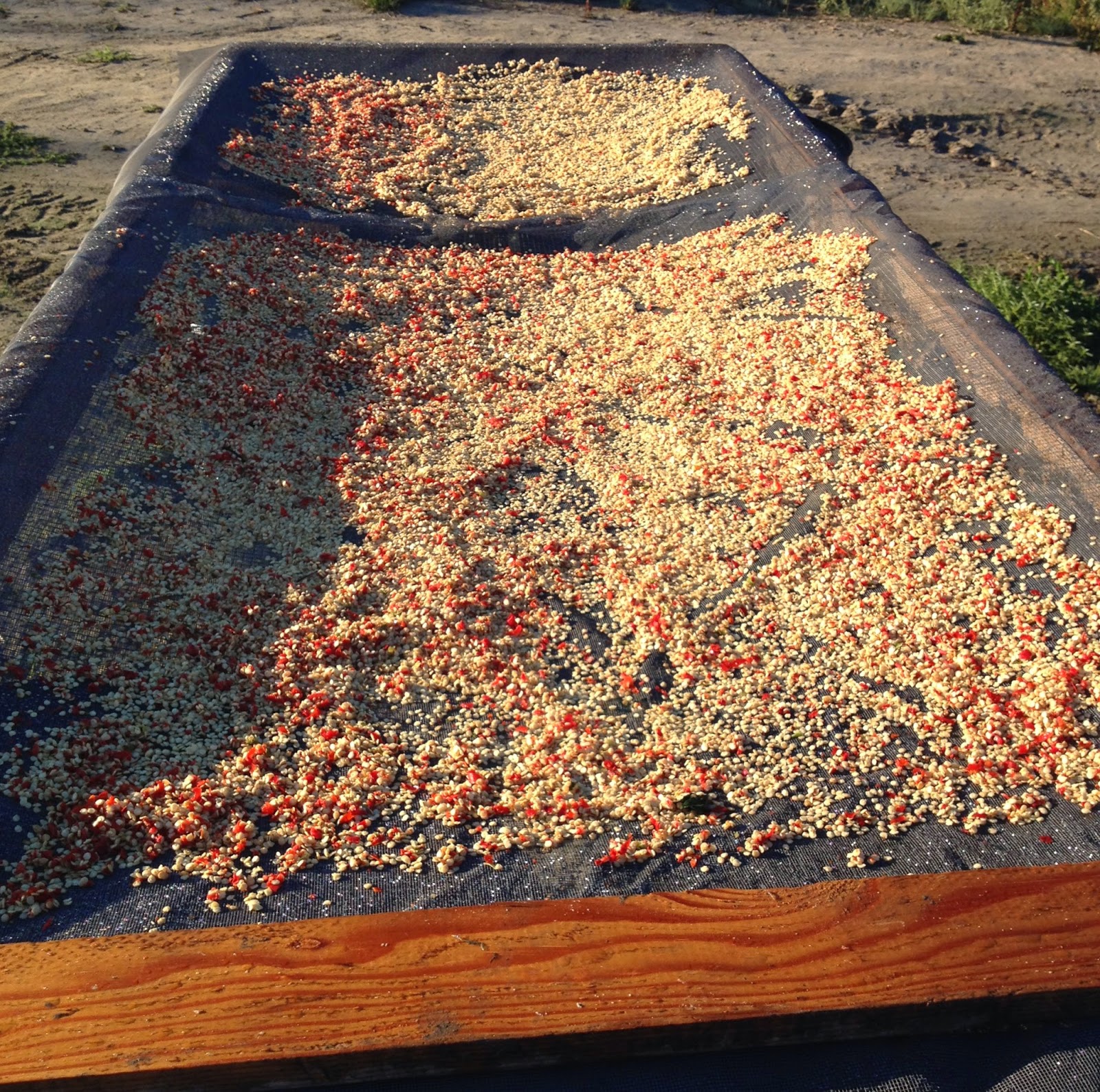
After the seed dries, it will go through a final winnowing to blow away the flecks of dried flesh. Then it's ready to go off to farmers and seed companies. Steve is representing Bill and several other trusted organic seed producers through Seed rEvolution Now. The price is $125 per quarter pound, although he is willing to sell smaller lots as well. You can email him at stevegrows@gmail.com, or call him at 505-660-3933.

Here's some shots of the fruit soon after it came to our home in San Mateo. I just can't say enough about the fantastic fresh eating quality of these peppers! But I'll try...

Thick, meaty, sweet, juicy, aromatic, rich and delicious!

And they make wonderful stuffers! Unlike Bell and Relleno type peppers, these have a tender skin and do not require peeling. Toothsome stuffed pimientos!

One last point in favor of these beauties: Here's a photo I just took today, October 27th, of a Red Ruffled Pimiento kept nearly a month without refrigeration! Pretty amazing, considering it was picked fully ripe! So hurry and get some of this seed to offer in your catalog or grow for your customers. Try it in your kitchen, give your kids a slice. It is just too good to pass up!

Wednesday, September 24, 2014

Dark Star Zucchini

Steve Peters of Seed Revolution Now would like to introduce what may well be the very best zucchini, bar none, for western climates: Dark Star


The star on the flower end of the maturing fruit is indicative of a high lutein content, and shows how this variety got its name...also derived from a Grateful Dead song!

Tucked into a bend in the Eel River in northern California lies a very special, hidden farm.


This is the land of organic produce grower and dedicated seed breeder Bill Reynolds. Bill is descended from a long line of strong, independent spirits. His great grandfather, for whom he was named, was the first sheriff of Nevada County during the gold rush. Bill has lived on this land for over thirty years, learning well how to work with the local natural givens of climate, soil and water.

Bill was already one of Steve's trusted cadre of organic seed growers when, in 2006, the opportunity arose for them to collaborate with Organic Seed Alliance plant breeder Dr. John Navazio to develop an improved open-pollinated zucchini at Eel River Produce Farm.

The location was especially suitable to this project. It was well-isolated, protecting the crop from unwanted cross-pollination. In addition, the high water table of this river bench allowed Bill to grow without any supplemental irrigation. This dry-farming forced the selection of plants which developed larger root systems. Bill had enough land to enable a sizable population, from which he selected those individual plants which showed the desired characteristics.

These traits include: an open habit, making harvest easy, and straight, smooth, shiny dark green fruit, with faceted sides to prevent rolling. In addition, this particular variety offers the nutritional advantaged of a high lutein content. Because it is open-pollinated, it has a much longer season of productivity than hybrids can muster. The continuous production of both male and female flowers guarantees that late season fruits remain straight. 

Dark Star plants, thanks to their stronger root systems, are about one third larger than other varieties. Their leaf stalks are sturdier, so they don't blow in the wind as readily, and are exceptionally smooth, resulting in less scarred fruit. The extra vigor has proved to offer some disease resistance and even frost tolerance on commercial organic farms. Their ability to thrive in areas with harsh sun makes them ideal for Western dry land farming. In fact, we advise against choosing this variety in areas that are very rainy or have comparatively low light, such as the North East, as the plants do too well, and spend their energy on vegetative growth. This is a good example of the importance of bioregional seed development.

Bill was able to witness the success of his efforts in person, as his seed was used on a huge organic farm in Baja California owned by a friend who hosted him there in the winters. The farmer preferred Dark Star to any of the hybrid varieties he had tried. In the above photo the plants on the left are hybrids. The difference is clear.

This farmer's production was very large, and wound up distributed in natural supermarkets across the US. A few years ago, a killing freeze hit Baja. All of the hybrid varieties succumbed, but Dark Star bounced back. For a while that winter, it was the only variety available in the stores. We were impressed!

Bill continues to work on improving Dark Star. This is strictly a one-man, hands-on operation, in which he takes a lot of pride. 

He has come up with some ingenious improvised tools to help process the seed. Here he stirs the fermented pulp.

A home-made sluice quickly cleans the seed.

Voila!
  
Seed Revolution Now and the Organic Seed Alliance continue to monitor this and other crop varieties on farms in many bioregions around the country. Here Bill and Steve visit Full Belly Farm in Northern California's Capay Valley, where a summer squash trial was run. Once again, you can see that the Dark Star plants, on the right, are about a third larger. They also once again demonstrated some tolerance to disease; in this case mosaic virus.

It is important to us to hear from the farmers what they think about the varieties. Steve also wants to get their ideas about what they will need in the future, to direct breeding efforts in useful ways.

 Our germination test in mid-September 2014 was 98% after three days. It wants to grow!

Dark Star is a proven performer on organic produce farms across the arid West. Certified organically grown seed is available in bulk quantities to farmers, seed companies and co-ops from Seed Revolution Now at pricing which is competitive and fair to all. Contact Steve Peters at www.stevegrows@gmail.org or call him at 505-660-3933 to inquire about this and our other fine vegetable seed offerings. 

Seed Revolution Now offers other services as well, including classes, consultations, and custom seed growing.
 Call Steve; he's not afraid to go out on a limb for you!

Wednesday, April 23, 2014

Broccoli and Napa Cabbage On-Farm Plant Breeding Projects at Fifth Crow Farm, in Pescadero, CA by Steve Peters


Open-pollinated, on-farm breeding offers important advantages to the farmer/breeder to adapt a crop to his or her unique environment. 


Fifth Crow Farm is a certified organic produce farm located near the Pacific coast in central California, a few miles from the picturesque town of Pescadero. The region is both blessed and challenged by the maritime climate. Summer and winter temperatures are moderate, and days are often foggy.

The good folks at Fifth Crow, Teresa Kurtuk, Mike Irving, and John Vars, were gracious enough to allow us to undertake a plant improvement project on their land. Over a delicious farm-fresh lunch, we discussed strategies for integrating the seed work with their on-going vegetable farming activities.


For this location, I chose to work with two OP brassicas; a Napa-type (heading) Chinese cabbage called Nozaki Early, and an heirloom broccoli called Early Green, favored for its high-yielding production of side shoots. In the commercial trade, both of these crops are dominated by F1 hybrid varieties, which means that farmers cannot save their own seed. We feel it is necessary to offer more choices of good quality open-pollinated varieties for seed sovereignty and food security.                        


My goal from the outset was to develop a vigorous and reliably-heading Napa cabbage, and a broccoli with tight, well-formed heads, and extended harvest.  Seedlings were placed in the field in early May. We planted about 750 transplants for each crop. 

The Napa cabbage seedlings were covered until mid-June, to protect them from flea beetles. The large populations provided me the opportunity to select only the very best plants (about 10% of the total) for seed production.


All selections were made prior to any flowering, to avoid pollination from culls. Chosen plants are flagged, and left to mature. This approach has the added benefit of allowing harvest for fresh produce of any plants not to be saved for seed.

With the Napa cabbage, I was selecting for sturdy, dense, upright heads of substantial size. The ideal form was  barrel shaped, however, I allowed for some variation in the size and shape, if a plant showed outstanding vigor.

 Culling began as soon as the floating row cover was removed, in mid-June. This plant was rogued-out, as it was a premature bolter. Rejects made great kimchee!

 Plants were also removed if they had loose heads, were stunted, or had other forms considered off-type. The maritime climate of this region provides an extra-long window of good brassica growing conditions. However, Napa cabbage, when sown in spring, has a tendency to form looser, more open heads because of increasing day length at this time.  Similarly, the florets of broccoli are also more open in spring plantings. The summer planting, with decreasing day length conditions, results in tighter, better-formed heads, and is generally considered the optimal planting time for these crops.

I chose to plant in spring deliberately, when days are lengthening, in order to observe plants in less than ideal conditions. This exaggerated the individual plant differences within the population, allowing for easier discrimination. Under perfect conditions, phenotypic variations could go unnoticed.

Within a few weeks we noticed a large number of sickly plants in both crops, particularly among the Napa cabbage.

On pulling these up, we discovered the problem: club root, or Plasmodiophora brassicae. It is caused by the invasion of a phytomyxea, a soil-borne plant parasite, into the roots, creating the obvious clubbed roots and hampering the plant's ability to uptake moisture and nutrients. More than one quarter of the population of both crops was removed due to this disease. These plants went into the landfill rather than the compost or to the chickens, to reduce the chance of spreading the infection.

While the entire field harbored this disease, certain areas were especially hard-hit, as can be seen by the gap in the middle of the plot above. At first this seemed like a disaster, but we quickly realized that, rather, it might be an opportunity to select for club root tolerance in our crops.

The broccoli was also affected by club root, though not as seriously as the Napa cabbage. 

The first Napa cabbage plants began flowering in late June, and by late July every remaining plant was flowering.

 Brassicas are insect pollinated, as might be guessed by the fairly showy and colorful flowers. Bees will travel up to a mile in search of nectar, so it is important to isolate seed crops from other flowering brassicas of the same species. Napa cabbage is Brassica rapa, the same species as turnips, and broccoli raab.

 This Early Green broccoli displayed good form and was left for seed. Broccoli is Brassica oleracea. This species also includes cauliflower, cabbage, kale (except Siberian kale), collards, Brussels sprouts, kohlrabi, and Chinese broccoli.

A great example of a big plant with many side shoots.

 I experimented with leaving the center head for seed on some plants, while harvesting it on others and allowing the side shoots to produce all the seed. There was not much difference in seed yield per plant between these approaches; therefore I recommend harvesting the center head for fresh produce...enjoy!

           Let the fun begin! All remaining plants (55 Napa cabbage; 72 broccoli) intermated promiscuously! No fear of cross-pollination between the two distinct species.

 The seed harvest window for the broccoli lasted for about 3 weeks - from late September to mid-October.  Whole plants, including roots, were pulled, then thoroughly dried in a sheltered, airy space.

Each plant was harvested and processed individually. Seed yields per plant ranged from 1-20 grams (2/3 oz) for Napa cabbage and 6-95 grams (over 3 oz) for broccoli.

The threshing step, i.e., removing the seed from its pod and stem, was accomplished by hand-rubbing. 

Seed from each plant was kept in its own labeled bag.

A small, round-holed screen allowed for all the seed (and a little chaff) to drop into the container below. 

Not quite clean...yet.

 The final cleaning step is to gently spill the seed in front of an electric fan. Before electricity, this winnowing was accomplished by tossing seed and chaff up in the wind. Lighter chaff is blown away, heavier, viable seed falls onto a tarp or container for collection.

With the cleaning process completed, the seed is put in individual bags. We have now begun year 2 of the project. Last year was the initial field selection. This year we will conduct the progeny testing. For both the Napa and the broccoli, we have planted 30 seeds from each of the 50 highest seed-yielding plants from last year. In a few weeks we will transplant out the most vigorous 15 plants from each of these, for a total population of 750 for each crop. In the coming year, I will evaluate each group of fifteen plants as a distinct "family". This is called progeny testing. As I discover superior families, I will eliminate the less desirable groups. I call this sheparding the good genes. More on this process in a future blog.